What Is a Fulfillment Center?
A fulfillment center is a facility designed to receive, store, process, and ship products on behalf of businesses.
Unlike a facility used primarily for long-term storage, a fulfillment center focuses on moving inventory through the warehouse and getting customer orders ready for delivery.
For an ecommerce business, it acts as the operational connection between available inventory and customer purchases.
For example, imagine you operate an online store selling kitchen accessories. You purchase 500 units from a manufacturer and send them to a fulfillment center.
The warehouse receives the products, records the quantities, assigns storage locations, and keeps track of available inventory.
When a customer purchases one of your products, the order information is transferred to the fulfillment system. Warehouse staff locate the item, pick it, pack it, and prepare it for shipping.
The process continues with every new order.
Depending on the provider, a fulfillment center may also offer additional services such as:
- Inventory management.
- Barcode scanning.
- Kitting and bundling.
- Custom packaging.
- Returns processing.
- Reverse logistics.
- Wholesale and bulk order preparation.
- Shipping coordination.
For growing businesses, using a fulfillment center can eliminate the need to manage their own warehouse, hire picking and packing staff, and coordinate every shipment internally.
How Does a Fulfillment Center Work? The Process Step by Step
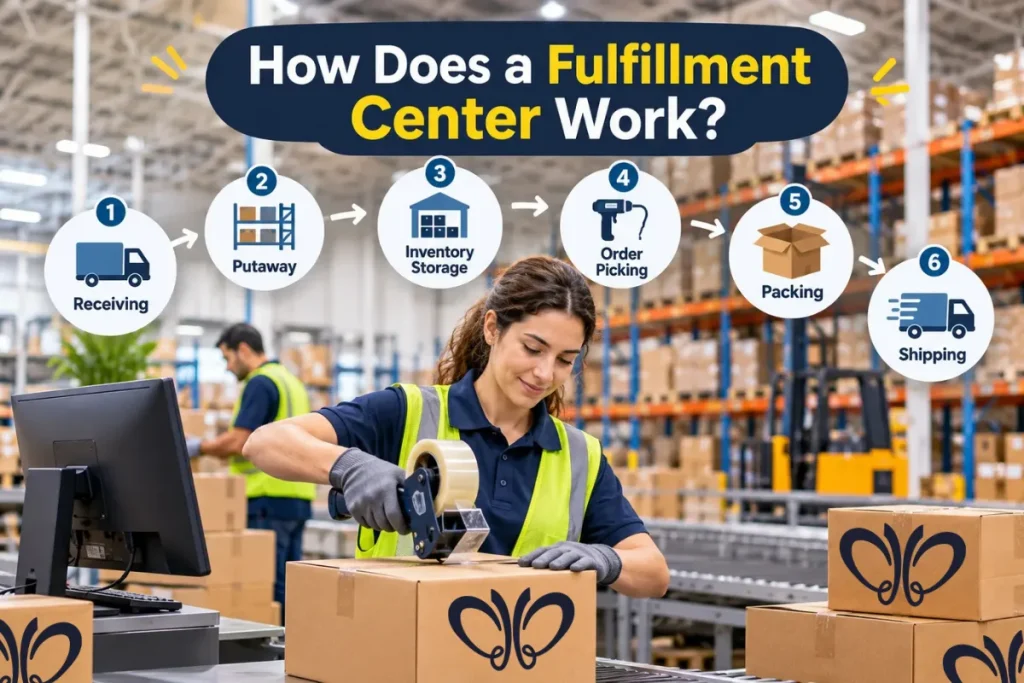
Every fulfillment center has its own warehouse layout, technology, and operating procedures. However, most follow six core steps to move products from receiving to shipment.
Here is how the process works.
The fulfillment process:
Receiving → Putaway → Inventory Management → Order Picking → Packing → Shipping
1. Receiving: Accepting Incoming Inventory
The fulfillment process begins when products arrive at the warehouse.
Inventory may come directly from a manufacturer, a supplier, a freight forwarder, or another distribution facility.
Before products are stored, warehouse staff need to receive and verify the shipment.
The receiving process typically involves:
- Checking incoming shipment documentation.
- Unloading cartons, pallets, or containers.
- Counting received products.
- Verifying SKUs and product descriptions.
- Inspecting packaging for visible damage.
- Recording received quantities in the warehouse management system.
- Reporting missing, damaged, or unexpected items.
For example, imagine your inventory records show that a supplier shipped 100 units of a product.
When the shipment arrives, the receiving team counts only 90 units.
If the discrepancy is not identified immediately, your inventory system may show products that are not physically available. This could result in overselling, delayed orders, and customer complaints.
Identifying the issue during receiving makes it easier to contact the supplier or investigate the shipment.
Why receiving matters: Accurate receiving establishes the starting point for inventory management. Errors at this stage can affect every activity that follows.
2. Putaway: Moving Products to Storage Locations
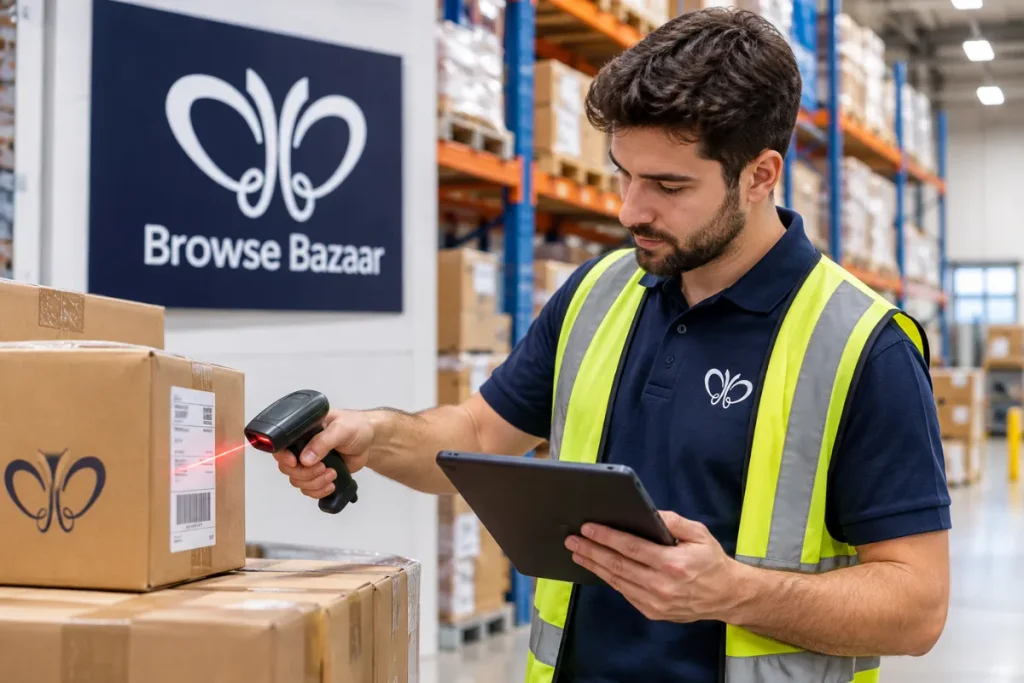
After inventory is received and recorded, the next step is putaway.
Putaway is the process of moving products from the receiving area to their assigned storage locations.
A fulfillment center may use different storage arrangements depending on product size, weight, demand, handling requirements, and available warehouse space.
Common storage locations include:
- Shelving units.
- Storage bins.
- Pallet racks.
- Floor storage areas.
- Dedicated product locations.
Warehouse management systems help employees identify where products should be stored and record their assigned locations.
For example, fast-moving products may be placed closer to picking and packing stations to reduce the time required to process orders.
Fragile, oversized, or sensitive products may require different storage arrangements.
Once products are placed in their assigned locations, their warehouse positions should be recorded accurately so employees can retrieve them later.
Why putaway matters: Organized storage reduces unnecessary movement, improves picking efficiency, and makes inventory easier to locate.

3. Inventory Management and Control
Storing products is only one part of warehouse operations. A fulfillment center must also maintain accurate inventory records as products enter, move through, and leave the facility.
Inventory management helps businesses understand how many units are available, where products are stored, and which items have been allocated to customer orders.
A warehouse management system (WMS) typically records:
- Product names and SKUs.
- Storage locations.
- Received quantities.
- Available inventory.
- Reserved inventory.
- Outgoing shipments.
- Damaged or unavailable stock.
- Inventory adjustments.
One common method used to maintain inventory accuracy is cycle counting.
Instead of counting every product in the warehouse at once, employees regularly check selected products or storage locations.
For example, a warehouse might count certain high-demand products every week and review other inventory categories on a rotating schedule.
If physical quantities do not match system records, the team investigates the discrepancy and updates the records when appropriate.
Inventory management may also involve batch tracking, barcode scanning, and stock movement reporting, depending on the products and the warehouse system.
Why inventory management matters: Accurate inventory records help businesses avoid overselling, understand stock availability, and make better purchasing and replenishment decisions.
4. Order Picking: Collecting Products for Customer Orders
When a customer places an order through an ecommerce store, the order information is transferred to the fulfillment system through an integration or another supported workflow.
The order is then released for processing.
A warehouse employee, known as a picker, receives instructions identifying the products and quantities required.
The picker travels to the assigned storage locations, collects the items, and brings them to the packing area.
Barcode scanners can help verify that the correct product and quantity have been collected.
Fulfillment centers use different picking methods depending on order volume, product variety, warehouse layout, and operational requirements.
Single-order picking: One employee collects all items for one customer order before moving to the next order. This can work well for smaller operations or orders containing multiple products.
Batch picking: An employee collects products for several orders during one warehouse trip. This can reduce unnecessary walking when multiple customers order the same items.
Zone picking: The warehouse is divided into different areas, and employees pick products only from their assigned zones. Orders move between zones until all required items are collected.
Wave picking: Orders are released in groups based on factors such as shipping deadlines, destinations, carrier schedules, or operational priorities.
Some warehouses combine these methods to improve productivity.
For example, a fulfillment center with thousands of daily orders may use batch picking and zone picking to reduce the time employees spend moving around the building.
Why order picking matters: Picking accuracy directly affects customer satisfaction. Selecting the wrong product, size, color, or quantity can result in returns, replacement shipments, and additional costs.
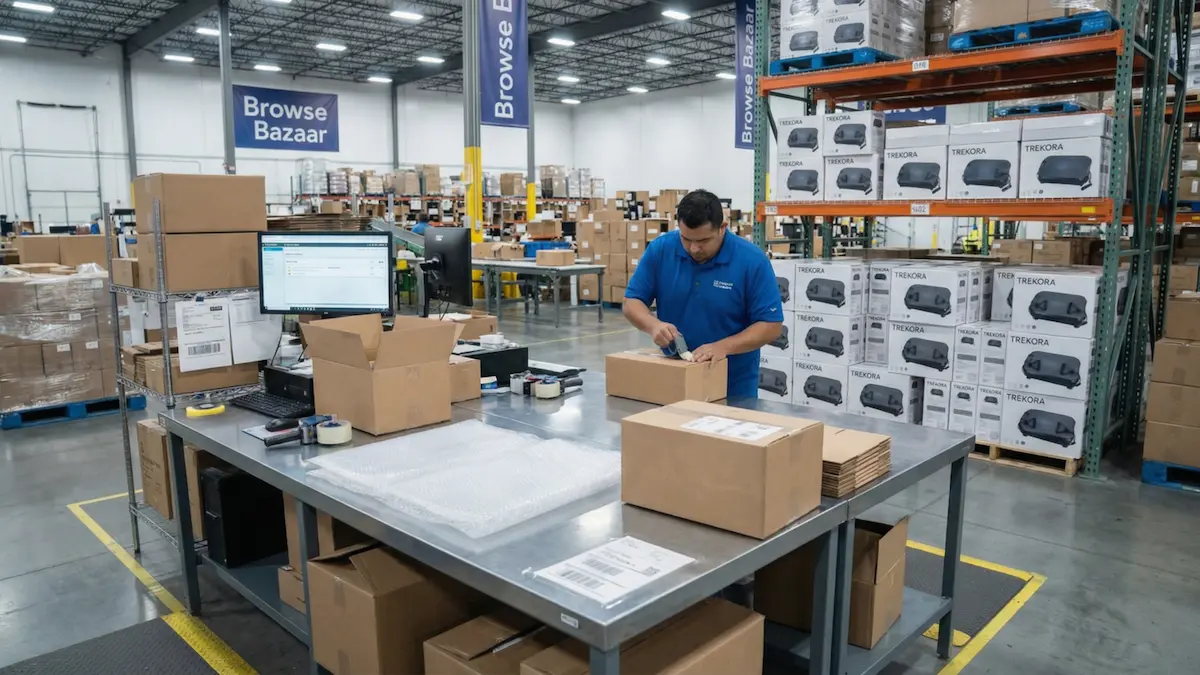
5. Packing: Preparing Orders for Shipment
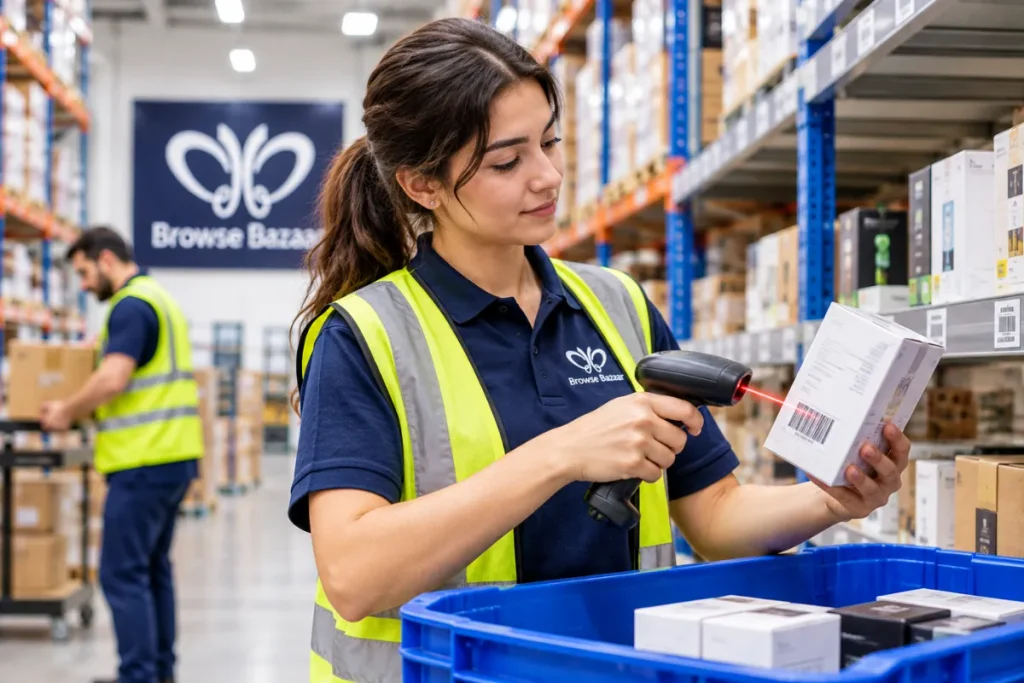
After products are picked, they move to a packing station.
This is where employees verify the order, select suitable packaging, and prepare the shipment.
Packing involves more than placing products inside a box. The packaging must protect the items during transportation while meeting the seller’s requirements.
A typical packing workflow includes:
- Checking product names and quantities against the order.
- Inspecting items for visible damage.
- Selecting an appropriate box, mailer, or packaging material.
- Adding protective materials when necessary.
- Including approved inserts or promotional materials.
- Applying the shipping label.
- Recording package information in the fulfillment system.
For example, a business selling glass kitchen accessories may need protective packaging to prevent damage during transportation.
A clothing seller may use poly mailers to reduce packaging costs and shipping dimensions.
Some fulfillment providers also offer branded packaging, custom inserts, and kitting and bundling services.
Kitting means combining several products into one prepared package. Bundling involves selling or shipping multiple items together as a product set.
These services can be useful for businesses selling promotional packages, product combinations, or customized orders.
Packaging decisions can also affect shipping costs. Oversized packages may increase dimensional weight charges, while insufficient protection can increase the risk of damage.
Why packing matters: Accurate packing protects products, reduces shipping problems, and helps create a better customer experience.
6. Shipping: Preparing Packages for Carrier Pickup
Once packages are sealed and labeled, they move to the shipping area.
Here, orders are organized for carrier pickup based on their shipping destination, service level, carrier, and scheduled collection time.
The shipping process may include:
- Verifying shipping addresses.
- Creating shipping labels.
- Selecting available carriers and shipping services.
- Sorting packages for carrier collection.
- Recording tracking information.
- Updating order fulfillment records.
- Preparing shipments for dispatch.
Fulfillment centers may work with multiple carriers to provide different shipping options, such as standard, expedited, and international services.
Shipping software can help compare available carrier rates, generate labels, and transmit tracking information to supported ecommerce platforms.
One important distinction is the difference between order processing time and shipping transit time.
Order processing time measures how long it takes the fulfillment center to receive an order, pick the products, pack them, and hand the shipment to the carrier.
Transit time measures how long the carrier takes to transport the package from pickup to delivery.
For example, an order packed at 2 p.m. may leave the fulfillment center that day if it meets the warehouse’s processing cutoff and the carrier’s collection schedule.
However, same-day processing does not mean same-day delivery.
Always ask a fulfillment provider about daily cutoffs, carrier pickup schedules, available delivery services, and how delayed shipments are handled.
Why shipping matters: The shipping process connects warehouse operations with the customer’s delivery experience. Accurate labeling, timely dispatch, and tracking visibility help reduce delivery problems.
Returns Processing and Reverse Logistics
The fulfillment process does not necessarily end when an order is delivered.
Customers may return products because they ordered the wrong size, changed their minds, received a damaged item, or experienced another issue.
Handling returned inventory is known as reverse logistics.
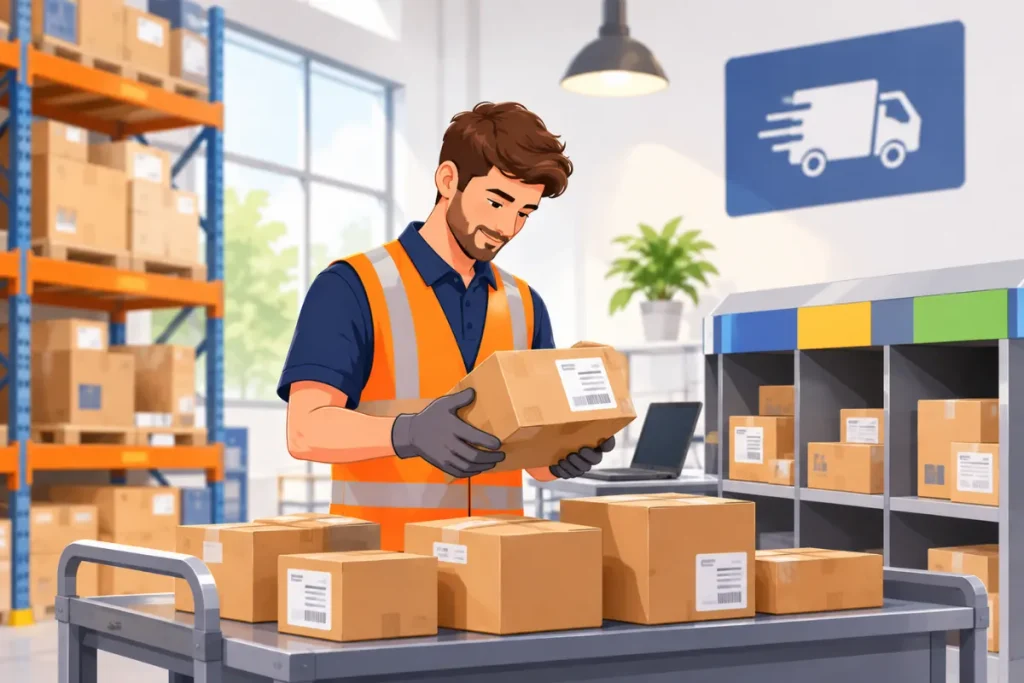
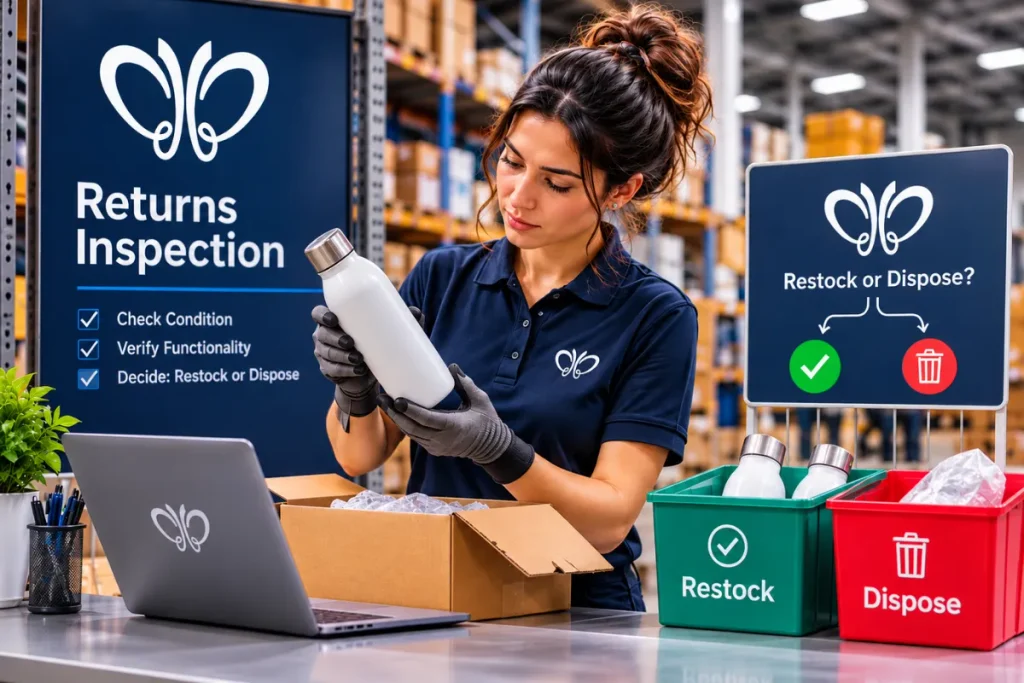
When a returned package arrives at the fulfillment center, the team may follow these steps:
1. Return Receiving: The returned package is received and matched to the relevant order or return authorization.
2. Product Identification: Staff identify the returned product, SKU, and quantity.
3. Product Inspection: The item is checked to determine its physical condition.
4. Condition Assessment: The product is categorized based on whether it is suitable for resale, needs further inspection, or is damaged.
5. Inventory Update: The return is recorded in the inventory system so stock information remains accurate.
6. Next-Step Processing: Depending on the seller’s instructions, the product may be restocked, held separately, returned to the supplier, repaired, or disposed of.
For example, an unopened product in good condition may be suitable for resale, while a damaged item should not automatically return to available inventory.
A structured returns process helps businesses maintain accurate inventory records and recover value from products that can be resold.
Not every fulfillment provider includes returns processing in its standard pricing, so it is important to clarify the available services and additional charges.
What Technology Is Used Inside a Fulfillment Center?
Technology helps coordinate inventory, customer orders, warehouse tasks, and shipping information.
The specific systems vary between facilities, but most modern fulfillment operations use a combination of warehouse software, barcode scanning, order management tools, and shipping technology.
Here are the main technologies.
1. Warehouse Management System (WMS)
A WMS helps manage daily warehouse operations.
Depending on the system, it can track:
- Inventory quantities.
- Product storage locations.
- Receiving activities.
- Putaway tasks.
- Picking and packing activities.
- Inventory adjustments.
- Stock movements.
The WMS helps employees locate products and maintain records of warehouse activity.
2. Order Management System (OMS)
An OMS manages order information from ecommerce platforms and other sales channels.
It can help coordinate incoming customer orders, order status, inventory allocation, and fulfillment workflows.
For businesses selling across several channels, an OMS can help centralize order information.
3. Barcode Scanners
Barcode scanners help employees identify products, storage locations, and shipments.
Instead of entering product information manually, employees scan barcodes to verify items and record inventory movements.
This can reduce manual entry errors and improve operational visibility.
4. Shipping Management Software
Shipping software helps fulfillment teams prepare packages for delivery.
Depending on the platform, it may support:
- Shipping label generation.
- Carrier rate comparisons.
- Service selection.
- Shipment tracking.
- Shipping documentation.
- Tracking updates to ecommerce stores.
5. Warehouse Automation Equipment
Larger fulfillment centers may use equipment such as conveyors, automated sorters, and other material-handling systems.
These systems can help move products and packages more efficiently, particularly in facilities processing large order volumes.
However, technology alone does not guarantee accurate fulfillment.
Product data must be correct, warehouse processes must be consistent, and employees need appropriate training.
A barcode scanner cannot prevent every inventory discrepancy, and an automated system cannot compensate for incorrect product information.
The most effective fulfillment operation combines appropriate technology with clear procedures and reliable warehouse management.
Fulfillment Center vs. Warehouse : What’s the Difference?
These two terms are related, but they describe different things.
A fulfillment center is a facility designed to receive inventory, store products, process customer orders, and prepare shipments for delivery.
A warehouse is a broader term for a facility used to store products. Some warehouses focus primarily on storage, while others also support picking, packing, and distribution.
A 3PL may operate its own warehouses and fulfillment centers or work with external facilities.
Here is a comparison:
| Aspect | Fulfillment Center | General Warehouse |
| What it is | A facility focused on order fulfillment | A facility primarily used for inventory storage |
| Receiving | Yes | Usually |
| Storage | Yes | Yes |
| Order picking | Yes | Depends on operations |
| Packing | Yes | Depends on operations |
| Shipping coordination | Yes | May be available |
| Returns management | Often available | Depends on facility |
| Technology | Often uses WMS and order systems | Varies |
For example, a business might rent warehouse space to store bulk inventory without needing individual customer orders processed daily.
Another business might outsource receiving, inventory management, picking, packing, and shipping to a 3PL operating a dedicated fulfillment center.
The right arrangement depends on your inventory requirements, order volume, sales channels, and how much of the logistics process you want to outsource.
For a broader explanation of outsourced logistics, read our guide: What Is 3PL Fulfillment? A Complete Guide for Businesses.
What to Look for in a Fulfillment Center
Choosing a fulfillment provider is an important operational decision. The wrong setup can create inventory discrepancies, shipping delays, unexpected fees, and additional work for your team.
Before selecting a provider, compare its services against your actual business requirements.
Here are the most important questions to ask.
1. Where Are the Fulfillment Centers Located?
Warehouse location influences shipping distances, delivery options, and transportation costs.
Consider where most of your customers are located and whether you need inventory stored in multiple regions.
For businesses selling in both Canada and the United States, having access to facilities in both markets may provide additional flexibility.
2. How Does the Provider Manage Incoming Inventory?
Ask how incoming products are counted, inspected, and recorded.
Find out how missing quantities, damaged cartons, and inventory discrepancies are reported.
3. What Inventory Management Technology Is Available?
Ask whether the provider uses a WMS and whether you can access inventory records, stock movements, and receiving information.
Confirm how often inventory updates are shared with your ecommerce store.
4. Which Ecommerce Platforms Are Supported?
If you sell through Shopify, Amazon, WooCommerce, or other channels, confirm that the fulfillment provider supports the platforms you use.
Ask which processes are automated, including order notifications, inventory synchronization, fulfillment confirmation, and tracking updates.
Do not assume that every integration supports every workflow.
5. What Are the Order Processing Cutoffs?
Ask when orders must arrive to qualify for same-day processing.
Also confirm the carrier pickup schedule and what happens to orders submitted after the daily cutoff.
6. How Are Picking and Packing Errors Prevented?
Ask how products are verified during picking and packing.
Barcode scanning, order verification, documented procedures, and inventory controls can all contribute to more accurate fulfillment.
7. Are Returns Management Services Available?
Confirm whether the provider receives, inspects, and processes returns.
Ask which activities are included in the standard agreement and which involve additional charges.
8. What Is the Complete Pricing Structure?
Do not compare providers using only their pick-and-pack rates.
Request a detailed fee schedule covering:
- Receiving.
- Storage.
- Pick and pack.
- Packaging materials.
- Shipping.
- Returns.
- Kitting and bundling.
- Technology or integration fees.
- Minimum monthly commitments.
- Inventory removal.
Ask for a sample invoice based on your actual order volume and product characteristics.
9. Can the Provider Scale With Your Business?
Your current operation may be relatively small, but your requirements can change quickly as sales increase.
Ask whether the provider can accommodate additional SKUs, seasonal volume increases, multiple sales channels, and new shipping destinations.
10. How Does the Provider Handle Operational Problems?
Finally, ask what happens when inventory is missing, an order is delayed, or a shipment is damaged.
A clear process for communicating, investigating, and resolving problems is essential to a reliable fulfillment relationship.
How Browse Bazaar Supports Ecommerce Fulfillment
Managing your own warehouse requires space, inventory systems, equipment, employees, and ongoing coordination with shipping carriers.
For many ecommerce businesses, outsourcing these activities can be a practical way to reduce operational workload and create more flexibility as the business grows.
Browse Bazaar provides 3PL and fulfillment services through fulfillment centers in Canada and the United States.
Our services help businesses manage inventory, process customer orders, prepare shipments, and coordinate distribution without having to operate their own fulfillment facilities.
- Warehousing and Inventory Management
- Order Fulfillment and Pick & Pack
- Kitting and Bundling
- Returns Management and Reverse Logistics
- Distribution and Worldwide Shipping
- Ecommerce Platform Integrations
- Fulfillment That Fits Your Business
Final Thoughts: Understanding the Fulfillment Process Helps You Choose the Right Partner
A fulfillment center works by connecting inventory management with customer order processing.
It begins with receiving products, recording quantities, and assigning storage locations. When orders arrive, warehouse employees pick the correct items, verify them, pack them, and prepare shipments for carrier pickup.
Returns processing and reverse logistics complete the process by helping businesses manage products that come back into the supply chain.
Each stage affects the next. Inaccurate receiving can lead to inventory discrepancies, poor storage organization can slow down picking, and incorrect packing can result in costly returns.
Understanding how these operations work makes it easier to evaluate fulfillment providers and identify the services your business actually needs.
For businesses that want to outsource warehouse operations, the right 3PL partner can provide the infrastructure, inventory management, and fulfillment support needed to process orders more efficiently.